 EN
EN
 AR
AR
 HR
HR
 CS
CS
 NL
NL
 FR
FR
 DE
DE
 IT
IT
 JA
JA
 KO
KO
 NO
NO
 PL
PL
 PT
PT
 RO
RO
 RU
RU
 ES
ES
 SV
SV
 TL
TL
 ID
ID
 VI
VI
 MT
MT
 TH
TH
 TR
TR
 AF
AF
 MS
MS
 AZ
AZ

Sampling Valve Connectors and Fittings — A Technical Guide to Selecting the Right Components for Gas and Liquid Sampling Systems
Summary In process industries ranging from petrochemical refining to semiconductor gas delivery, the accuracy of analytical measurements depends entirely on the integrity of the sample. A contaminated or unrepresentative sample — caused by dead volume in a connector, a reactive fitting material, or a leaking valve seat — produces analytical data that is worse than useless: it is actively misleading. Sampling valve connectors and fittings, though physically small components in the broader instrumentation chain, are the most common failure points in sampling system design. This article provides a technical overview of sampling connector types, material selection criteria, and application-specific design considerations for engineers and system integrators building gas and liquid sampling panels.
Part 1: The Anatomy of a Sampling System — Why Connectors Matter More Than Valves
A typical grab sampling system for gas or liquid consists of four functional blocks: the process tap and isolation valve, the sample transport line, the sample conditioning section (filtration, pressure reduction, temperature control), and the sample collection point — usually a cylinder, bottle or direct instrument inlet. Between every block sits a connector or fitting.
The most common sampling system failures are not valve failures. Industry maintenance data shows that over 60% of sampling system integrity problems originate at connectors and fittings: cross-threaded connections that leak, incompatible materials that react with the sample, dead legs that trap previous sample residue, and thermal cycling that loosens compression joints. A well-designed sampling panel starts with connector selection, not valve selection.
Four connector types dominate industrial sampling applications:
• Compression tube fittings with double-ferrule design — the workhorse of gas sampling systems. The front ferrule provides the primary seal against the tubing while the rear ferrule grips the tube for vibration resistance. In high-purity applications where helium leak testing is required, double-ferrule fittings in SS316L with electropolished wetted surfaces achieve leak rates below 1×10⁻⁹ mbar·L/s. These are the standard choice for semiconductor gas sampling panels, laboratory GC carrier gas lines, and any application where sample integrity depends on zero atmospheric contamination.
• CGA (Compressed Gas Association) connectors — the standardized interface between sample cylinders and filling/emptying manifolds. CGA connections use a specific thread and nipple configuration matched to the gas type, preventing accidental cross-connection between incompatible gases. CGA-350 for hydrogen, CGA-580 for nitrogen and inert gases, CGA-590 for silane, and CGA-330 for corrosive gases each have unique geometries. A sampling system that fills multiple gas types into cylinders must include gas-specific CGA pigtail assemblies to prevent cross-contamination.
• Quick-connect and quick-disconnect fittings — used where the sample point requires frequent connection and disconnection, such as portable analyzers, field sampling kits, and multi-point sampling manifolds. Double-shutoff quick-connects seal both the male and female halves upon disconnection, preventing atmospheric contamination of the sampling line and sample release to the environment. For hazardous gas sampling, self-sealing quick-connects with secondary locking mechanisms are mandatory.
• Diaphragm-sealed and bellows-sealed connectors — used when the sample must be completely isolated from metallic wetted surfaces, elastomeric O-rings, or atmospheric exposure. These are specified for ultra-high-purity sampling in semiconductor fabs, corrosive gas sampling in chemical plants, and any application where parts-per-billion level contamination control is required.
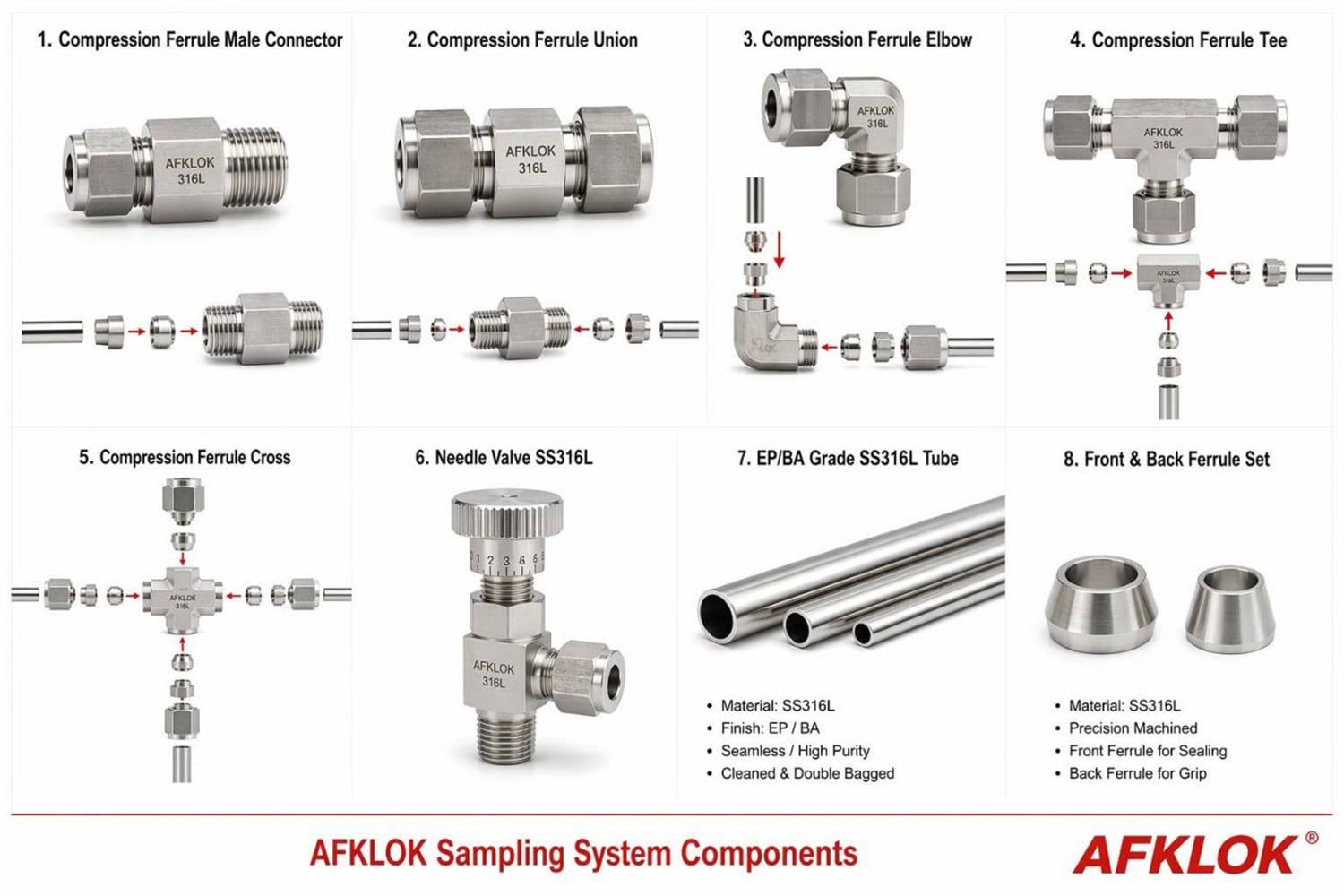
Figure : AFKLOK tube fitting — nut, rear ferrule, front ferrule, needle valves, and SS316L tubing
Part 2: Material Selection — The Difference Between a Representative Sample and a Contaminated One
The single most consequential connector selection decision is material. An incorrect material choice does not cause immediate system failure — it silently contaminates every sample the system produces, sometimes for months before the analytical discrepancy is detected.
SS316L is the default material for industrial gas and liquid sampling connectors. Its molybdenum content (2-3%) provides pitting resistance in chloride-containing environments. Electropolished SS316L with surface roughness below 0.5 μm Ra minimizes particulate generation and adsorption of moisture and hydrocarbons — critical for trace-level gas analysis. For hydrocarbon sampling in refinery applications, SS316L connectors prevent the catalytic reactions that can occur on carbon steel surfaces, preserving the sample's original composition.
Hastelloy C-276 connectors are specified when the sample stream contains wet chlorine, hydrochloric acid, or mixed acid environments. Standard stainless steel grades pit rapidly in these conditions. Hastelloy's nickel-chromium-molybdenum matrix provides near-universal corrosion resistance at a material cost premium of 3-5× over SS316L — justified only when the process chemistry demands it.
PTFE and PFA-lined connectors serve applications where even electropolished stainless steel introduces unacceptable contamination risk. Semiconductor-grade gas sampling for ICP-MS trace metal analysis and pharmaceutical process validation sampling use fully fluoropolymer-wetted flow paths. The trade-off is mechanical — PTFE cold-flows under compression, requiring periodic retorquing of fittings that stainless steel connections do not need.
For high-temperature sampling above 200°C — common in refinery vapor sampling and stack gas emission monitoring — connector material selection must account for thermal expansion mismatch between the fitting body and the tubing. Inconel 625 connectors paired with SS316L tubing create differential expansion that can cause leaks on thermal cycling. Matched-material connections (Inconel fittings with Inconel tubing, or all-SS316L systems) eliminate this failure mode.
Part 3: Application-Specific Design Considerations
The most effective sampling connector selection decisions are driven by the specific failure modes of the target application:
Semiconductor bulk gas sampling: The primary risk is contamination, not leakage. Even a 10 ppb moisture spike from a connector's internal surface can cause a false quality alarm on a nitrogen or argon delivery system. Connectors must be electropolished SS316L, orbitally welded where possible, and helium leak-tested. Dead legs — any connector cavity that traps gas between sampling cycles — must be eliminated through zero-dead-volume fitting designs or continuous purge configurations.
Refinery and petrochemical sampling: The primary risks are safety and sample representativeness. Liquid samples containing dissolved hydrogen sulfide will outgas into the vapor space of poorly designed connectors, producing vapor-phase samples that do not represent the liquid composition. Sample cylinder connectors must be rated for the maximum process pressure with appropriate safety factors, and double-block-and-bleed valve configurations at the process tap prevent uncontrolled release during connector disconnect.
Pharmaceutical and food-grade sampling: Connectors must be crevice-free and drainable to support clean-in-place (CIP) and steam-in-place (SIP) protocols. Tri-clamp sanitary fittings with EPDM or PTFE gaskets are standard. The connector material must have full traceability documentation — heat codes, material certificates per EN 10204 Type 3.1, and surface finish certification — to satisfy FDA and EU GMP audit requirements.
Laboratory gas chromatography: The connector's internal volume directly affects analytical performance. A connector with 50 μL of internal dead volume on a GC carrier gas line will cause peak broadening and retention time drift. Low-dead-volume fittings with 0.25 mm internal bores are standard for capillary GC applications, while packed-column systems can tolerate larger-bore connectors.
Conclusion Sampling valve connectors and fittings may be the physically smallest components in a process analytical system, but they carry a disproportionate share of system integrity responsibility. Every connector is a potential leak path, a potential contamination source, and a potential point of sample alteration. Selecting connectors by application-specific failure mode — rather than by generic specification sheet — is the difference between sampling systems that produce reliable analytical data and those that silently undermine every measurement they take.
Media Contact & Company Profile
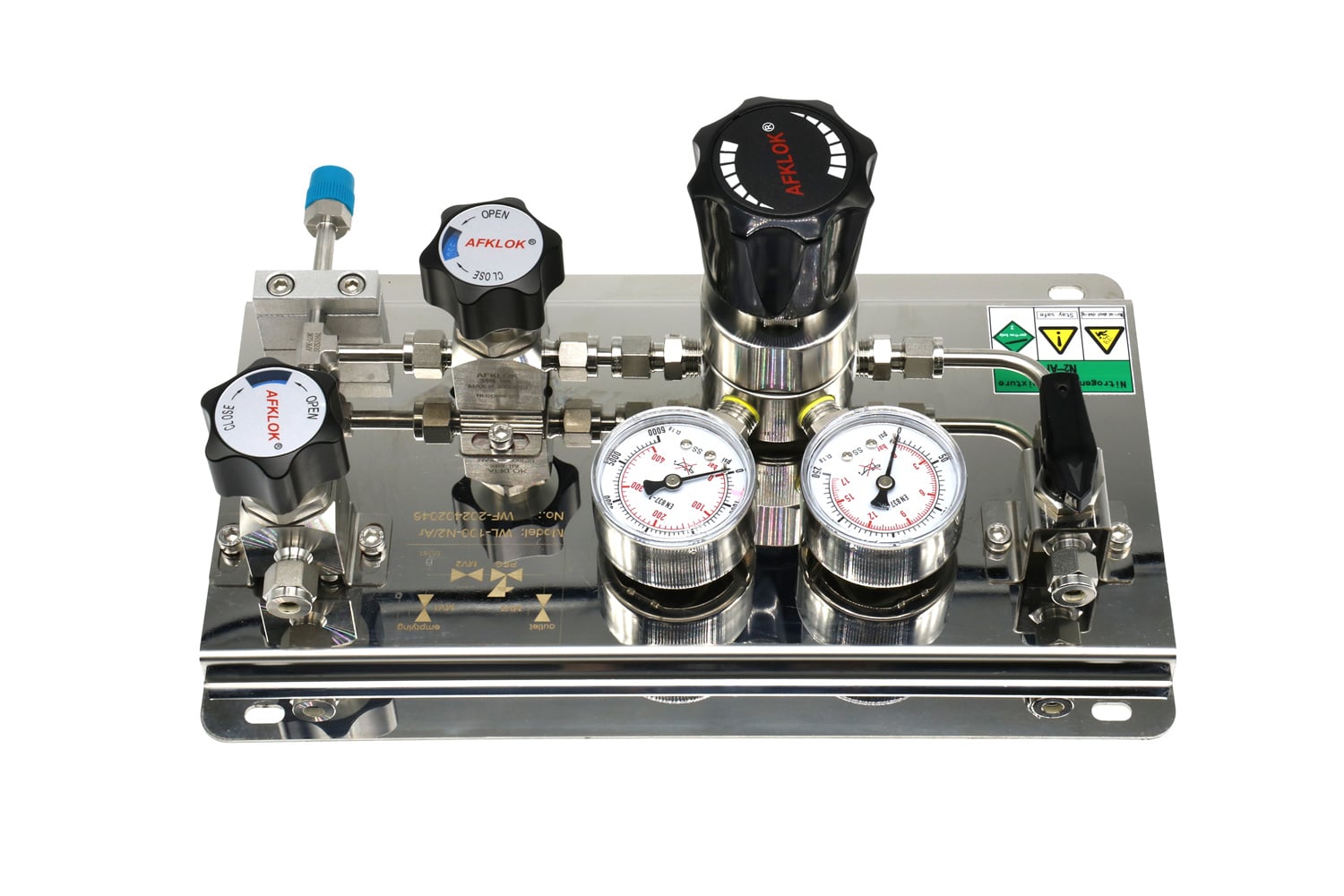
Shenzhen Wofly Technology Co., Ltd. is a 15-year ISO-certified manufacturer of industrial fluid system components, specializing in high-purity gas handling for semiconductor, laboratory, pharmaceutical and petrochemical applications. The AFKLOK product portfolio includes SS316L compression fittings, CGA connectors, quick-connect sampling fittings, diaphragm valves, pressure regulators and integrated gas sampling panels.
For technical consultation, material compatibility assessments or sampling system configuration support, contact the AFKLOK Fluid Systems Engineering Team at www.szwofly.com.