 EN
EN
 AR
AR
 HR
HR
 CS
CS
 NL
NL
 FR
FR
 DE
DE
 IT
IT
 JA
JA
 KO
KO
 NO
NO
 PL
PL
 PT
PT
 RO
RO
 RU
RU
 ES
ES
 SV
SV
 TL
TL
 ID
ID
 VI
VI
 MT
MT
 TH
TH
 TR
TR
 AF
AF
 MS
MS
 AZ
AZ
Dry Scrubbing Technology Establishes New Safety Benchmark for Semiconductor Exhaust Abatement, Eliminating Single-Point Failure Risks That Threaten Fab Continuity
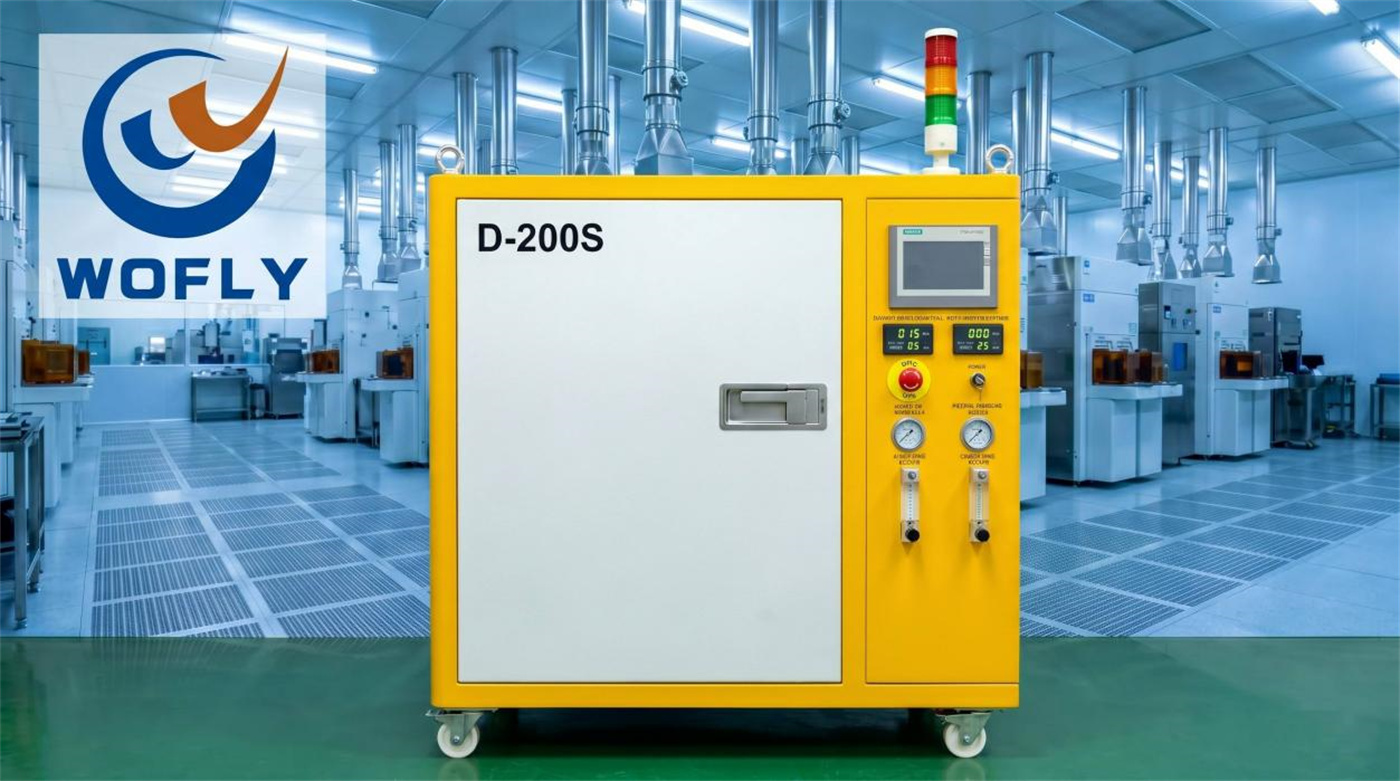
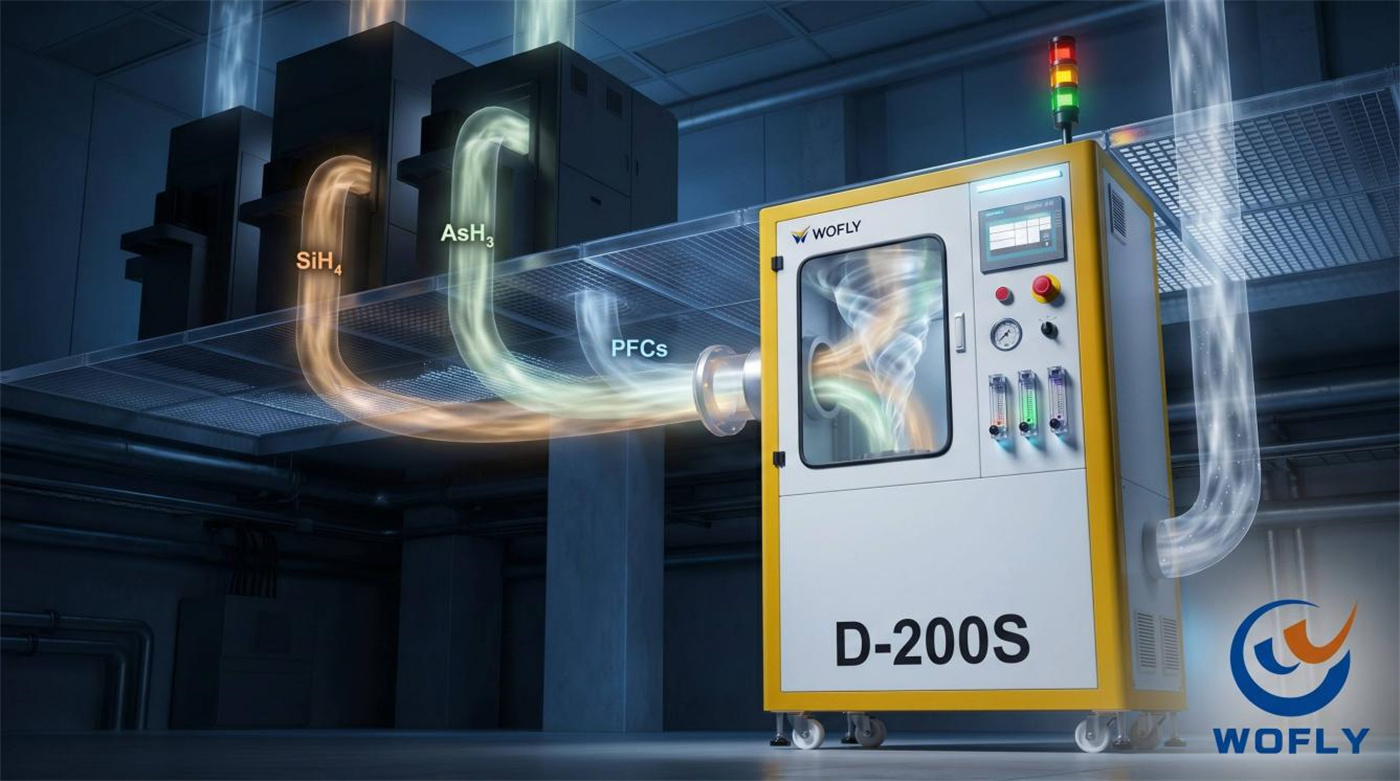
Summary Across the global semiconductor industry, toxic process exhaust represents the most underappreciated catastrophic risk in fab operations. While billions are invested in cleanroom particle control, lithography precision and wafer handling automation, the sub-fab exhaust abatement infrastructure — the last line of defense between hazardous process gases and fab personnel — has historically received disproportionately low engineering attention. Single-canister scrubbers without automatic bypass, units lacking real-time exhaust concentration monitoring, and installations dependent on manual changeout procedures have created systemic vulnerabilities that expose fabs to evacuation events, regulatory non-compliance findings and uninsured business interruption losses. Shenzhen Wofly Technology's D-200S dry scrubber directly addresses these legacy safety gaps with an integrated design philosophy that treats every canister changeout, every pressure excursion and every temperature anomaly as a design-driving failure scenario — not an acceptable operational risk.
Part 1: Why Point-of-Use Exhaust Abatement Safety Is Non-Negotiable for Modern Semiconductor Fabs
Analysis of semiconductor fab safety incident databases reveals a consistent pattern: the most severe toxic gas events originate not in the process chamber or gas cabinet, but in the exhaust abatement system downstream. Four systemic risk categories define the problem that purpose-engineered dry scrubbers must solve:
1. Prevent catastrophic toxic gas release during adsorbent changeout The highest-risk operational moment for any dry scrubber occurs when the saturated adsorbent canister is disconnected for replacement. In single-canister designs without bypass capability, this creates a direct open path from the process tool exhaust line to the sub-fab environment. Even with purging protocols, residual toxic gases adsorbed on spent media surfaces can desorb during canister handling. A documented incident at a Southeast Asian foundry involved arsine exposure exceeding the IDLH threshold during what was supposed to be a routine canister change — the outcome of a scrubber design that treated safety as a procedural issue rather than an engineering requirement. The D-200S eliminates this exposure scenario entirely: its 5.5L automatic bypass canister maintains continuous exhaust treatment throughout the changeout cycle, with the Siemens PLC executing the switchover in under two seconds.
2. Eliminate backpressure-induced exhaust into process chambers As adsorbent media compacts and fines accumulate over months of continuous operation, flow resistance through the packed bed increases. Without active pressure management, backpressure builds upstream into the process tool exhaust line — and eventually into the process chamber itself. This carries not only untreated toxic gases but also particulate contaminants from the adsorbent bed, capable of causing wafer scrap events that dwarf the cost of the scrubber itself. The D-200S variable-frequency exhaust fan, driven by real-time inlet-outlet differential pressure measurement, maintains stable negative pressure regardless of media compaction state, eliminating risk for the full adsorbent service life.
3. Detect and neutralize exothermic runaway before thermal damage occurs Certain gas-adsorbent reactions — particularly silane, arsine and phosphine chemisorption — release significant heat. In poorly monitored scrubber designs, localized hot spots within the adsorbent bed can escalate into thermal runaway, decomposing the media, releasing previously captured gases and potentially igniting hydrogen (a silane decomposition byproduct). The D-200S deploys temperature sensors at multiple depths within the 200L canister, linked to an automated high-flow nitrogen cooling injection system. The interlock logic initiates cooling at the first temperature excursion — not at the alarm threshold — preventing the thermal escalation cascade that single-sensor designs cannot catch until it is too late.
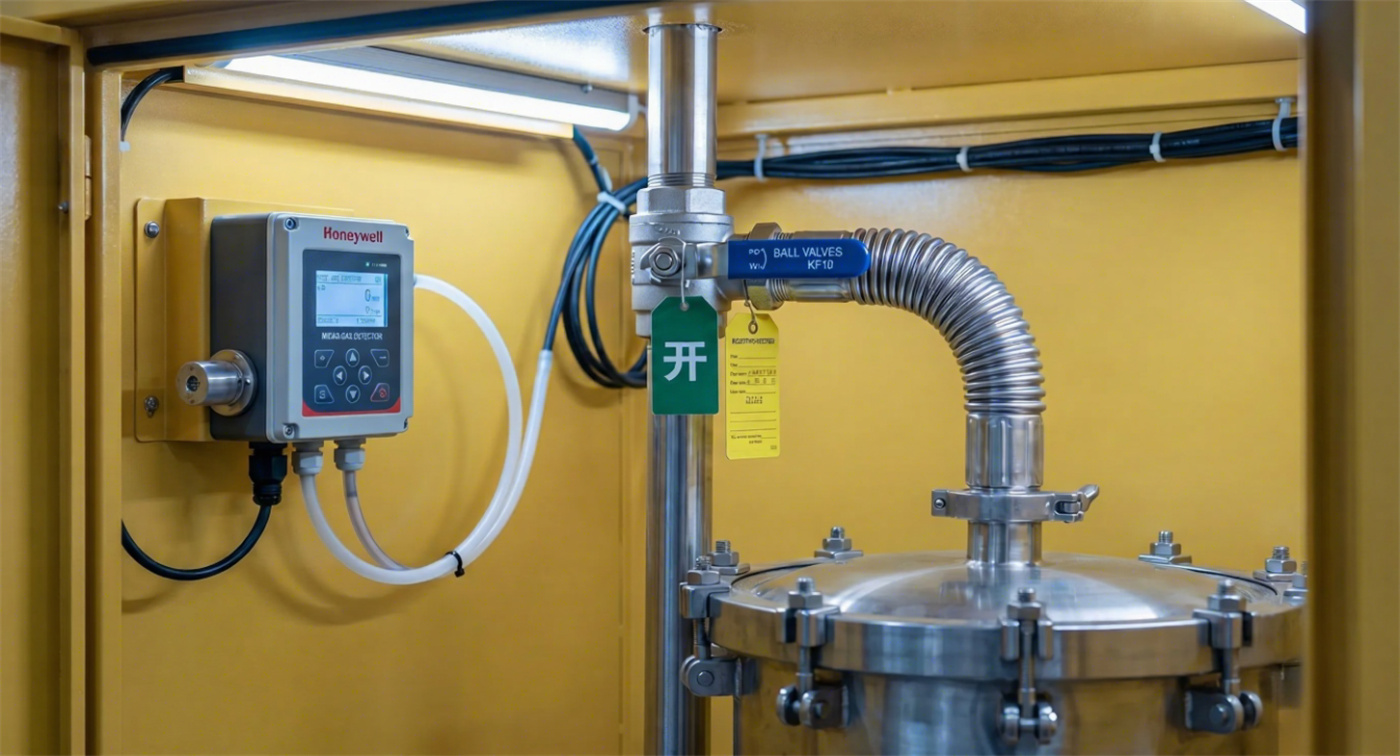
4. Ensure regulatory compliance with verifiable destruction efficiency Global semiconductor emission regulations — China GB 31573, US EPA NESHAP, EU IED — increasingly require not just abatement equipment installation but documented, continuous evidence of destruction efficiency. Legacy scrubbers without exhaust concentration monitoring rely on periodic manual sampling that provides compliance data only at the moment of measurement — not between measurements. The D-200S supports optional Honeywell gas detector integration at the exhaust outlet, providing real-time concentration data logged by the Siemens PLC. This continuous monitoring record satisfies regulatory auditors and provides early warning of adsorbent saturation before any emission limit is breached.
Part 2: Engineering Philosophy That Sets the D-200S Apart — Design for Failure, Not for Specification
Traditional scrubber procurement focuses on specification sheets: flow rate, removal efficiency, dimensions, power consumption. These parameters describe normal operation. The D-200S is engineered around abnormal operation — the edge cases, upset conditions and human error scenarios that specification sheets ignore but safety incidents are made of.
The automatic bypass architecture is the most visible expression of this philosophy. Most dry scrubbers on the market offer bypass as an optional add-on or omit it entirely. The D-200S treats bypass as a non-negotiable core safety function — integrated into the PLC logic, pressure interlock chain, and alarm management hierarchy from the initial design, not retrofitted as an afterthought. When inlet pressure exceeds the setpoint, when exhaust concentration rises, or when the operator initiates a manual changeout, the bypass sequence executes identically — two-second valve actuation, continuous exhaust treatment, zero atmospheric release.
The self-developed adsorbent media reflects the same philosophy applied to lifecycle economics. Scrubber vendors that source adsorbent from third-party chemical suppliers create a cost dependency that their customers cannot escape — every canister replacement triggers a purchase order at whatever price the sole-source supplier demands. Wofly Technology's independent adsorbent development and manufacturing capability breaks this dependency. SiH₄ adsorption capacity exceeding 25 L/L and HCl capacity exceeding 80 L/L are verified performance numbers, not theoretical maxima — and they are achieved with media produced in-house, at costs that reflect direct manufacturing economics rather than a distributor's markup chain.
The Siemens control platform — PLC plus touchscreen HMI — provides capabilities that microcontroller-based scrubber controllers cannot match. Over 1,000 alarm events are stored with timestamps and parameter snapshots, enabling root cause analysis that a simple alarm light can never support. The Ethernet interface allows integration with fab-wide facility monitoring systems (FMS) and SCADA platforms. Password-protected parameter settings prevent unauthorized adjustment of safety-critical thresholds. These are not luxury features — they are operational requirements for any fab operating under ISO 14001 environmental management or pursuing SEMI S2 equipment safety certification.
The compact footprint — 1,000 × 800 × 2,200 mm — is an engineering outcome, not a marketing bullet point. In sub-fab environments where every square meter carries utility routing, maintenance access and seismic restraint requirements, equipment volume directly determines installation feasibility. The D-200S fits within standard sub-fab bay layouts without requiring structural modification or utility re-routing — a practical advantage that spec-sheet comparisons of "dimensions" fail to capture.
Part 3: Raising the Industry Standard — From Procedural Safety to Engineered Safety
The semiconductor industry has made remarkable progress in process tool safety — gas cabinets with integrated leak detection, interlocked valve sequencing, automated emergency shutdown — yet exhaust abatement has lagged behind. The gap between a process tool's billion-transistor precision and its downstream scrubber's 1980s-era safety architecture represents the industry's most glaring infrastructure inconsistency.
"Every semiconductor fab operator knows that the most dangerous moment in dry scrubber operation is canister changeout," said a Wofly Technology senior process safety engineer. "Yet the industry standard for decades has been to manage this risk through procedures — written protocols, operator training, personal protective equipment. Procedures are essential, but they are not engineering controls. A procedure cannot execute a bypass switchover in two seconds. A procedure cannot detect a hot spot forming deep inside an adsorbent bed. The D-200S was designed to replace procedural safety margins with engineered safety margins — to make the scrubber the reason an incident does not occur, rather than the reason an incident requires emergency response."
This distinction — between procedural safety and engineered safety — defines the threshold that separates legacy exhaust abatement from modern point-of-use dry scrubbing. As semiconductor fabs scale to higher throughput, tighter geometries and more chemically diverse process flows, the cost of a scrubber failure — in fab downtime, regulatory exposure, insurance premiums and workforce safety — increasingly dwarfs the differential between an entry-level unit and a purpose-engineered system. The D-200S represents Wofly Technology's conviction that exhaust abatement should be the strongest link in the fab safety chain, not the weakest.
Media Contact & Company Profile
For gas-specific adsorbent compatibility assessments, D-200S technical specifications, on-site demonstration arrangements or volume quotation requests, contact the Wofly Technology Exhaust Abatement Team. Shenzhen Wofly Technology Co., Ltd. is a 15-year ISO-certified manufacturer of industrial gas system components and engineered abatement solutions. The company's D-200S dry scrubber is deployed in semiconductor fabs, R&D cleanrooms and compound semiconductor facilities across Asia, with full factory engineering support, on-site commissioning and multi-region after-sales service. All products are supported by complete batch traceability documentation, CE compliance certification and independent adsorbent media performance verification.