 EN
EN
 AR
AR
 HR
HR
 CS
CS
 NL
NL
 FR
FR
 DE
DE
 IT
IT
 JA
JA
 KO
KO
 NO
NO
 PL
PL
 PT
PT
 RO
RO
 RU
RU
 ES
ES
 SV
SV
 TL
TL
 ID
ID
 VI
VI
 MT
MT
 TH
TH
 TR
TR
 AF
AF
 MS
MS
 AZ
AZ

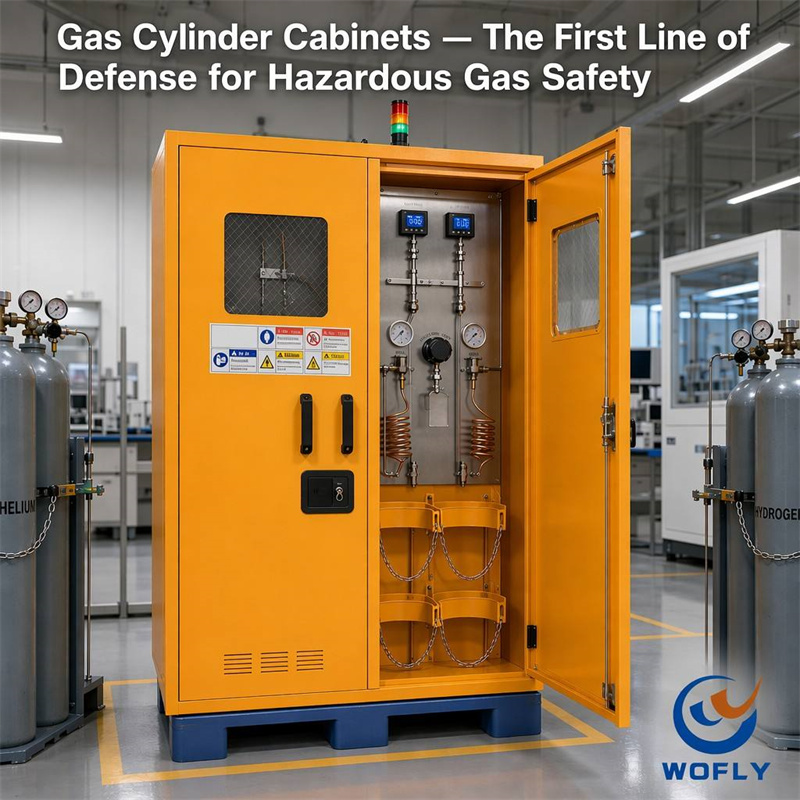
Gas Cylinder Cabinets — The First Line of Defense for Hazardous Gas Safety in Laboratory and Industrial Environments
Summary Compressed gas cylinders are among the most underestimated hazards in laboratories, pharmaceutical facilities and chemical processing plants. A single leaking cylinder of helium, hydrogen, silane or ammonia — left undetected in an unmonitored storage area — can cause oxygen depletion, fire, explosion or toxic exposure before personnel are even aware of the breach. Gas cylinder cabinets are the engineered safety solution that transforms passive cylinder storage into active hazard management: containing leaks, detecting gas releases, triggering automatic gas shutoff, and maintaining uninterrupted supply through intelligent switching. Shenzhen Wofly Technology's QG-series gas cylinder cabinets integrate semi-automatic purge-enabled supply panels, multi-sensor alarm systems and PLC-controlled safety interlocks into a single purpose-built enclosure, addressing the full chain of gas safety risks that standard storage racks and unmonitored cylinder stations cannot.
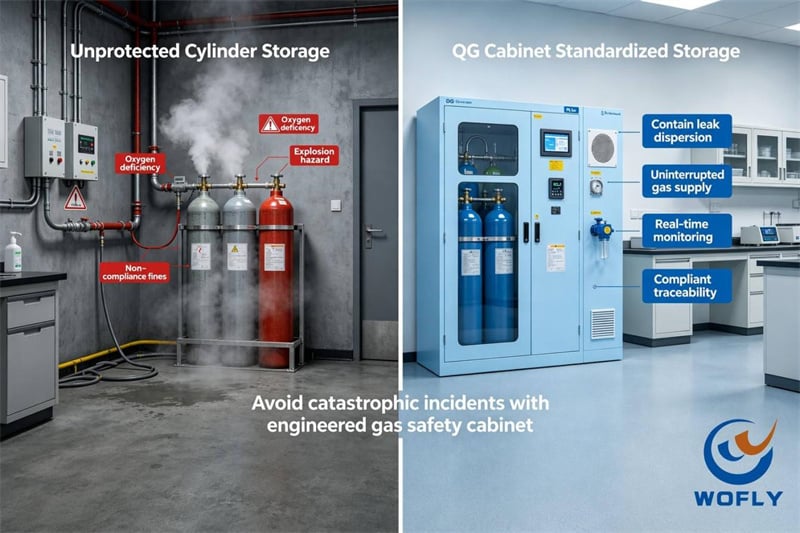
Part 1: The Real Risks of Unprotected Cylinder Storage
Industry safety data consistently identifies compressed gas cylinders as a top-five hazard category in laboratory and industrial environments. The risks are deceptively simple:
Gas leaks are invisible until detected. Helium, nitrogen, argon and carbon dioxide are odorless and colorless. A slow leak from a loose cylinder valve connection or a degraded pigtail fitting can displace oxygen in an enclosed room without any sensory warning. Oxygen depletion below 19.5% causes impaired judgment; below 16%, loss of consciousness within minutes. In laboratories where personnel work at benches adjacent to cylinder storage, the time between a leak starting and a medical emergency can be measured in minutes.
Toxic and flammable gases multiply the risk profile. Hydrogen has a wide flammability range (4-75% in air) and an ignition energy as low as 0.02 mJ — a static discharge from a lab coat can ignite a hydrogen-air mixture. Silane is pyrophoric, igniting spontaneously on contact with air. Ammonia, chlorine and hydrogen chloride are toxic at parts-per-million concentrations. For facilities handling these gases, a cylinder cabinet is not optional equipment — it is the engineering control that prevents a gas release from becoming a casualty event.
Regulatory compliance is tightening globally. NFPA 55 (Compressed Gases and Cryogenic Fluids Code) specifies maximum allowable quantities, separation distances and ventilation requirements for gas cylinder storage. OSHA 1910.101 mandates compliant storage and handling. Local fire codes increasingly require gas detection and automatic shutoff for toxic and flammable gas storage. Non-compliance exposes facilities to fines, insurance liability and, in the event of an incident, criminal negligence exposure.
Part 2: How an Engineered Gas Cylinder Cabinet Eliminates the Risk Chain
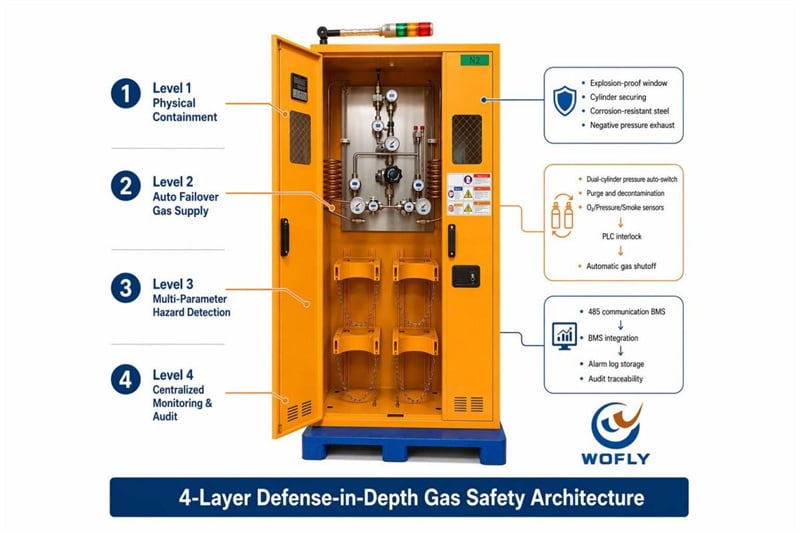
Wofly Technology's QG-series gas cylinder cabinet addresses gas safety at four levels, creating a defense-in-depth architecture that no standalone safety device can match:
· Level 1 — Physical containment. The 1.5mm galvanized steel cabinet body, acid-washed and phosphated for anti-corrosion and anti-static protection, provides a durable primary enclosure. An explosion-proof glass observation window allows visual inspection without opening the cabinet. Ventilation windows and a top-mounted exhaust port (designed for axial fan connection at 200-300 Pa negative pressure) maintain continuous air exchange, preventing gas accumulation even before detection thresholds are reached. Adjustable cylinder clamps and a bottom flip pedal simplify safe cylinder loading and unloading — reducing the most operator-error-prone step in cylinder handling.
· Level 2 — Intelligent gas supply with automatic failover. The semi-automatic supply panel operates on a pressure-differential switching principle: two cylinder positions, each with a set-pressure regulator, create a deliberate pressure bias so that the higher-pressure side supplies gas first. As the primary cylinder depletes, pressure drops to a critical threshold (triggering a low-pressure alarm), and the secondary cylinder automatically assumes supply. This architecture guarantees uninterrupted gas delivery without operator intervention — eliminating the production downtime and data loss that occur when a single cylinder runs empty during an overnight experiment or continuous process run. The purge function, activated via dedicated purge valves on each supply side, removes atmospheric contamination after cylinder changeout, preserving gas purity for analytical applications.
· Level 3 — Multi-parameter hazard detection. The cabinet integrates three independent detection channels: pressure sensors on both cylinder supply lines (4-20mA output), an O2 concentration detector for inert gas leak monitoring, and a smoke detector for fire early warning. Unlike standalone gas detectors that only sound an alarm, the cabinet's PLC controller executes programmed safety responses: a stage-1 alarm (audible/visual alert) for pre-threshold warnings, and a stage-2 alarm that triggers automatic electromagnetic gas shutoff when critical thresholds are breached.
· Level 4 — Centralized monitoring and audit trail. The integrated alarm box logs all alarm events with timestamps and channel identifiers, storing approximately one week of history. A 485 data interface enables connection to building management systems (BMS) or facility monitoring platforms. This transforms gas safety from a local, operator-dependent function into a documented, auditable system — satisfying the documentation requirements of ISO 45001 occupational health and safety management and GLP laboratory compliance frameworks.
Part 3: Who Needs a Gas Cylinder Cabinet — And What Gas Types Are Covered
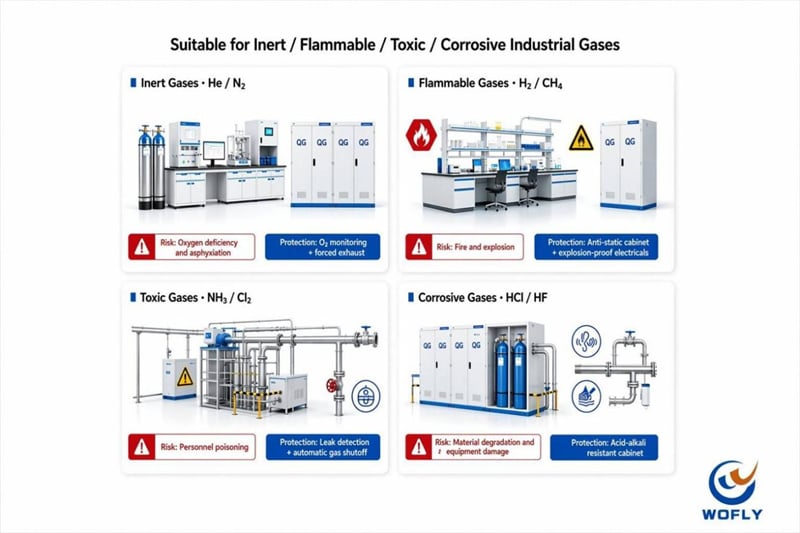
The QG-series cabinet is configured per application, supporting the full range of laboratory and industrial gases:
Inert gases (He, N2, Ar, CO2) — used in GC carrier gas, ICP-MS plasma gas, glovebox purge, and cryogenic applications. The primary risk is oxygen displacement. O2 concentration monitoring and forced ventilation are the critical safety functions.
Flammable gases (H2, CH4, C2H2, C3H8) — used in FID fuel gas, hydrogenation reactions, and flame sealing. The cabinet's anti-static construction, explosion-proof electrical components and gas detection interlock are essential.
Toxic gases (NH3, Cl2, HCl, H2S) — used in chemical synthesis, semiconductor etching, and water treatment. The automatic shutoff function triggered by gas concentration detection is the decisive safety feature.
Corrosive gases (HCl, Cl2, HF) — used in chemical processing and semiconductor cleaning. The acid-resistant cabinet construction prevents structural degradation over extended exposure.
If your facility stores compressed gas cylinders in occupied workspaces — whether in a university research lab where graduate students work late nights next to helium and hydrogen cylinders, a pharmaceutical QC lab running validated GC methods that cannot tolerate carrier gas interruptions, a hospital medical gas storage room where patient safety depends on reliable oxygen supply, a semiconductor fab where silane or ammonia leaks could trigger a facility-wide evacuation, or an environmental testing station where multiple calibration gas cylinders share the same storage area — the question is not whether you can afford a gas cylinder cabinet. The question is whether you can afford the consequences of operating without one. A single overnight gas supply failure in an analytical lab costs more in lost samples, instrument recalibration and investigator time than the cabinet that would have prevented it. A single reportable gas exposure incident costs more in regulatory penalties, insurance premiums and reputational damage than a fleet of cabinets. Gas cylinder cabinets are not capital equipment — they are operational insurance, and they pay for themselves the first time they prevent a failure rather than document one.
Media Contact & Company Profile
Shenzhen Wofly Technology Co., Ltd. is a 15-year ISO-certified manufacturer of industrial gas system components and safety equipment, including gas cylinder cabinets, semi-automatic supply panels, gas detectors, pressure regulators, valves and manifold systems. The QG-series gas cylinder cabinet is custom-configured for specific gas types and application requirements, with full factory testing and on-site commissioning support. For technical specifications, gas compatibility assessments or configuration proposals, contact the WOFLY Gas Safety Systems Team at www.szwofly.com.