 EN
EN
 AR
AR
 HR
HR
 CS
CS
 NL
NL
 FR
FR
 DE
DE
 IT
IT
 JA
JA
 KO
KO
 NO
NO
 PL
PL
 PT
PT
 RO
RO
 RU
RU
 ES
ES
 SV
SV
 TL
TL
 ID
ID
 VI
VI
 MT
MT
 TH
TH
 TR
TR
 AF
AF
 MS
MS
 AZ
AZ
How Integrated Thermal Decomposition and Two-Stage Water Scrubbing Delivers Superior Exhaust Gas Abatement for Semiconductor Manufacturing
Summary Semiconductor manufacturing generates exhaust gas streams that combine thermal, chemical, and particulate challenges in a single flow — silane that decomposes to sticky silicon dioxide dust, NF3 and fluorinated compounds that demand both high-temperature destruction and acid gas neutralization, and hydrogen that introduces deflagration risk. No single abatement technology — dry adsorption, wet scrubbing, or thermal oxidation alone — addresses all three challenges simultaneously.
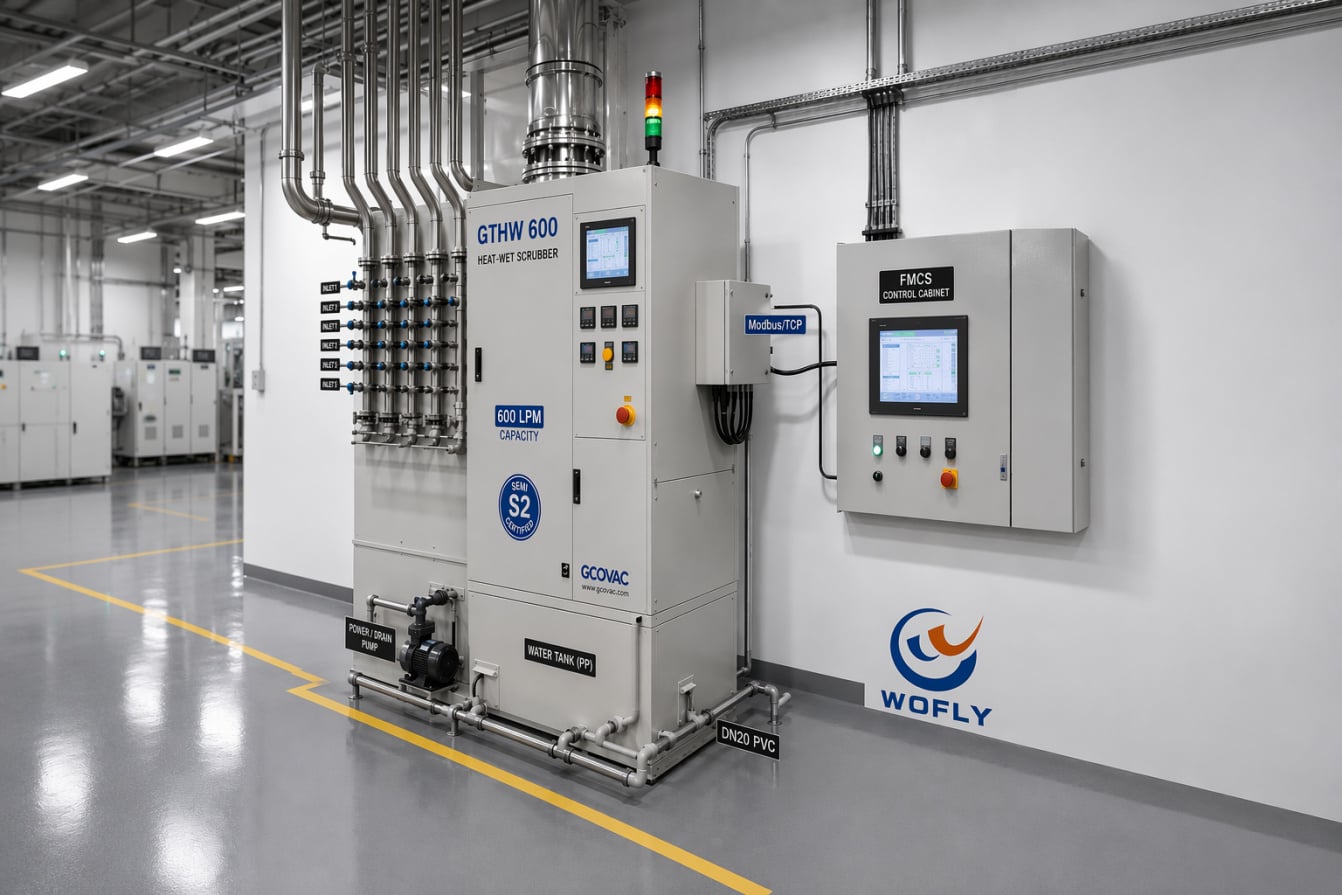
The WOFLY GTHW 600 Heat-Wet Scrubber integrates electric thermal decomposition with two-stage packed-tower water scrubbing in a single 600 LPM system, purpose-engineered for the mixed-gas, mixed-hazard reality of CVD, PECVD, and dry etch exhaust. This article examines the GTHW 600's five-stage treatment process, the engineering logic behind its inner/outer chamber isolation design, and how its integrated thermal-wet architecture outperforms standalone abatement technologies across the metrics that semiconductor facility engineers care about: destruction efficiency, maintenance interval, and total cost of ownership.
Part 1: Why Standalone Abatement Technologies Fail the Mixed-Gas Challenge
Semiconductor process exhaust is chemically diverse in ways that stress single-mechanism abatement systems:
CVD and PECVD processes using silane (SiH4) produce silicon dioxide (SiO2) as a combustion byproduct — a fine, adhesive powder that clogs dry adsorbent beds within weeks and coats burner nozzles in thermal oxidizers. Dry scrubbers must be oversized to accommodate premature media saturation from particulate loading; thermal oxidizers require frequent burner cleaning that drives up maintenance labor.
Etch processes using NF3, CF4, and SF6 generate acid gases (HF, HCl) that rapidly corrode metallic components in thermal abatement systems and overwhelm the acid-neutralization capacity of single-pass wet scrubbers. These gases demand both high-temperature destruction to break the strong C-F and N-F bonds and alkaline wet scrubbing to neutralize the resulting acid vapors.
Hydrogen, used as a carrier and annealing gas, introduces deflagration risk in thermal abatement. Combustion-based systems must manage hydrogen's wide flammability range (4-75%) with careful dilution and flame arrestor design. Dry scrubbers, operating at ambient temperature, avoid this risk entirely but cannot handle the accompanying silane and acid gases at scale.
The GTHW 600's integrated architecture addresses this mixed-gas reality with a sequenced treatment train: thermal decomposition handles the high-bond-energy gases, water scrubbing neutralizes the acid byproducts and captures particulates, and the system's material engineering — Teflon-coated reaction chamber, PP water tank, N2 gas curtain moisture isolation — ensures that corrosive byproducts do not degrade the equipment itself.
Part 2: Five-Stage Treatment Process — How GTHW 600 Works
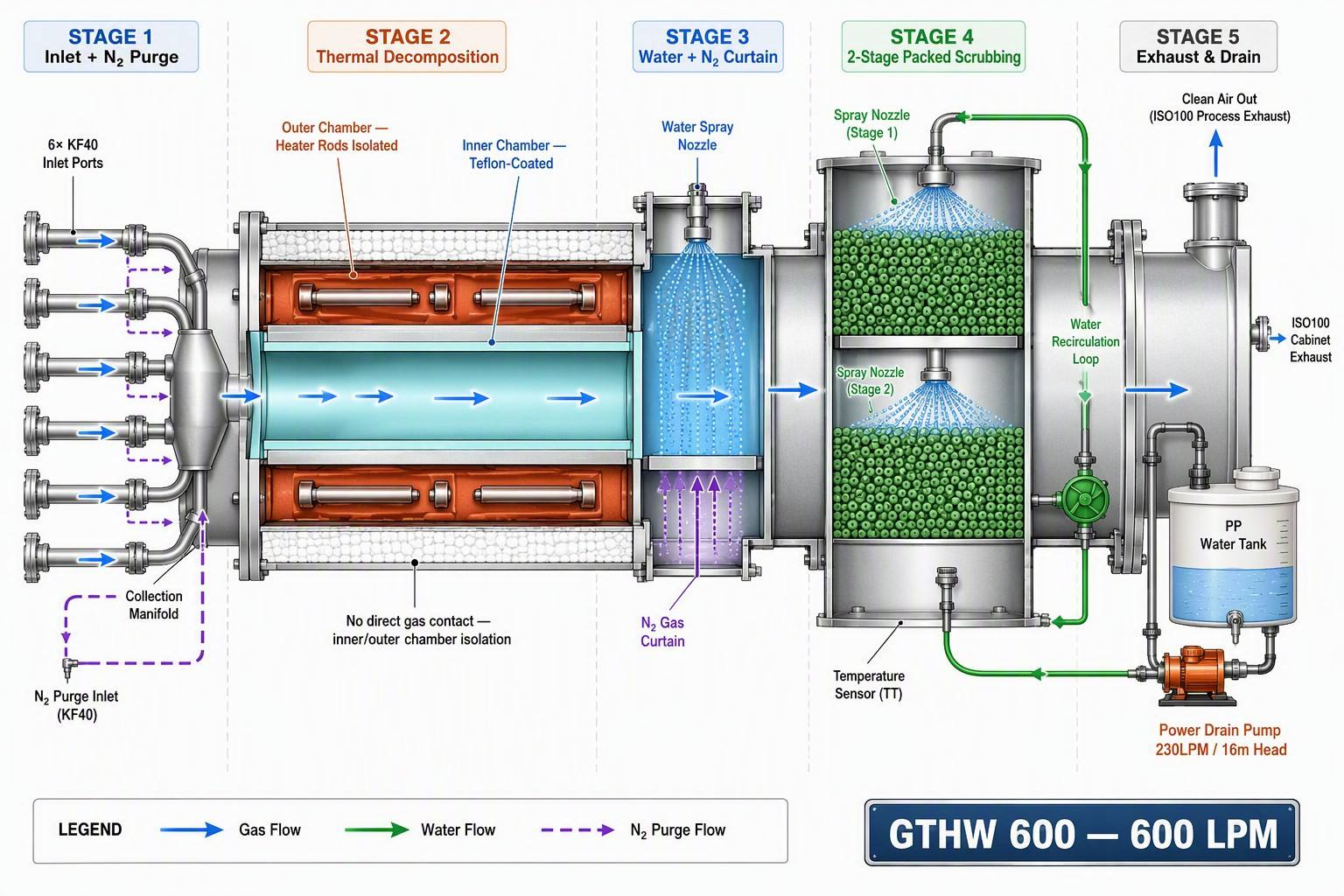
Stage 1 — Centralized Inlet with N2 Purge. Six KF40 process gas inlets feed into a central collection manifold that simultaneously reduces gas velocity and extends high-temperature zone residence time. An automatic N2 purge function prevents dust accumulation at the inlet manifold — addressing the most common maintenance pain point reported by fab equipment technicians for multi-port scrubber systems. By slowing gas velocity at the entry point rather than relying on downstream flow control, the manifold design ensures complete thermal exposure without increasing the reaction chamber footprint.
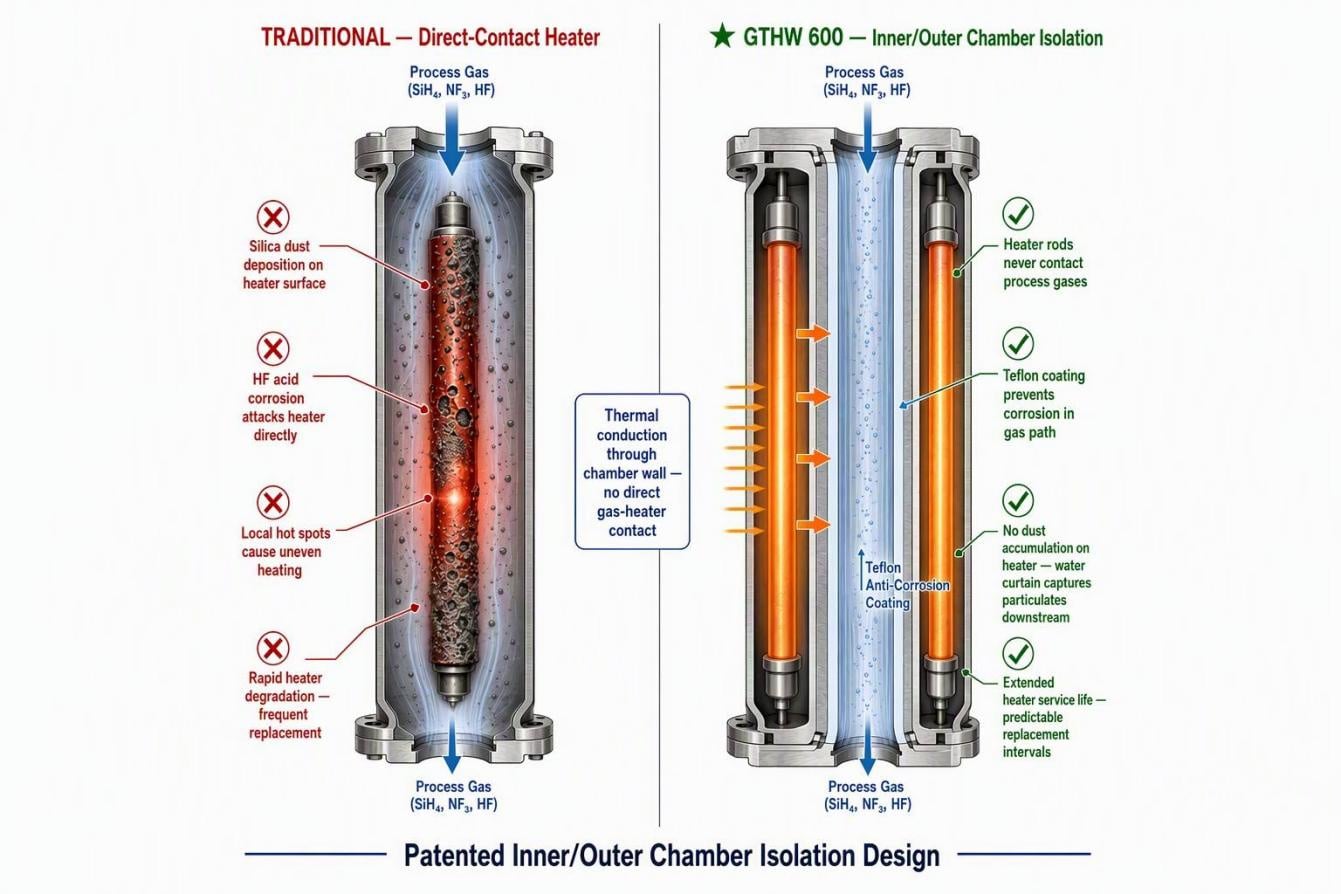
Stage 2 — High-Temperature Thermal Decomposition. The reaction chamber uses electric heater rods operating within an inner/outer chamber isolation design: the heaters are positioned in the outer chamber and transfer heat through the chamber wall to the process gases flowing through the inner chamber. This is the single most consequential design decision in the GTHW 600. In direct-contact heater designs — where the heating element is exposed to the process gas stream — corrosive gases and particulate deposition degrade the heater surface, creating hot spots, reducing thermal efficiency, and ultimately causing premature heater failure. The GTHW 600's isolated design eliminates this failure mechanism. Heater rods never contact process gases. The inner chamber surface is Teflon-coated for corrosion resistance. The result is significantly longer heater service life and reduced unscheduled maintenance compared to direct-contact thermal abatement systems.
Stage 3 — Water Curtain Cooling and N2 Gas Curtain Isolation. As thermally decomposed gases exit the reaction chamber, they pass through a uniform water curtain that serves a dual function: cooling the gas stream to protect downstream components, and — critically — preventing the silica dust generated from silane decomposition from adhering to the tube walls. Without this water curtain, SiO2 powder accumulation would progressively narrow the exhaust passage, increasing backpressure and eventually requiring mechanical cleaning. A nitrogen gas curtain follows the water curtain, creating a moisture barrier that isolates water vapor from upstream components and slows internal corrosion in metal sections.
Stage 4 — Two-Stage Packed-Tower Wet Scrubbing. The cooled, dust-free gas enters a dual-nozzle packed scrubbing tower. Packing media — inert structured material with high surface-area-to-volume ratio — maximizes gas-liquid contact, ensuring that acidic byproducts (HF from NF3 decomposition, HCl from DCS decomposition) are efficiently absorbed into the circulating water stream. The two-stage design provides sequential scrubbing: the first stage handles the bulk acid load, the second provides polishing. A temperature sensor at the tower outlet continuously monitors exhaust gas temperature, providing real-time process data for safety interlocks and trend analysis.
Stage 5 — Controlled Exhaust and Power Drain. Treated gas exits through an ISO100 process exhaust port, designed for connection to the fab's central exhaust system at -100 to -50 mmH2O negative pressure. A separate ISO100 cabinet exhaust port handles enclosure ventilation. The PP (polypropylene) water tank features a multi-barrier structure to prevent foreign matter from entering the recirculation pump. Drainage is actively managed by a power drain pump — not gravity — capable of 230 LPM at up to 16 meters of head, with a pneumatic ball valve and check valve combination that prevents backflow. This active drainage design eliminates the installation constraint of requiring a below-grade drain connection, simplifying facility integration in existing fab utility layouts.
Part 3: GTHW 600 vs. Dry Adsorption and Combustion — When Integrated Thermal-Wet Wins
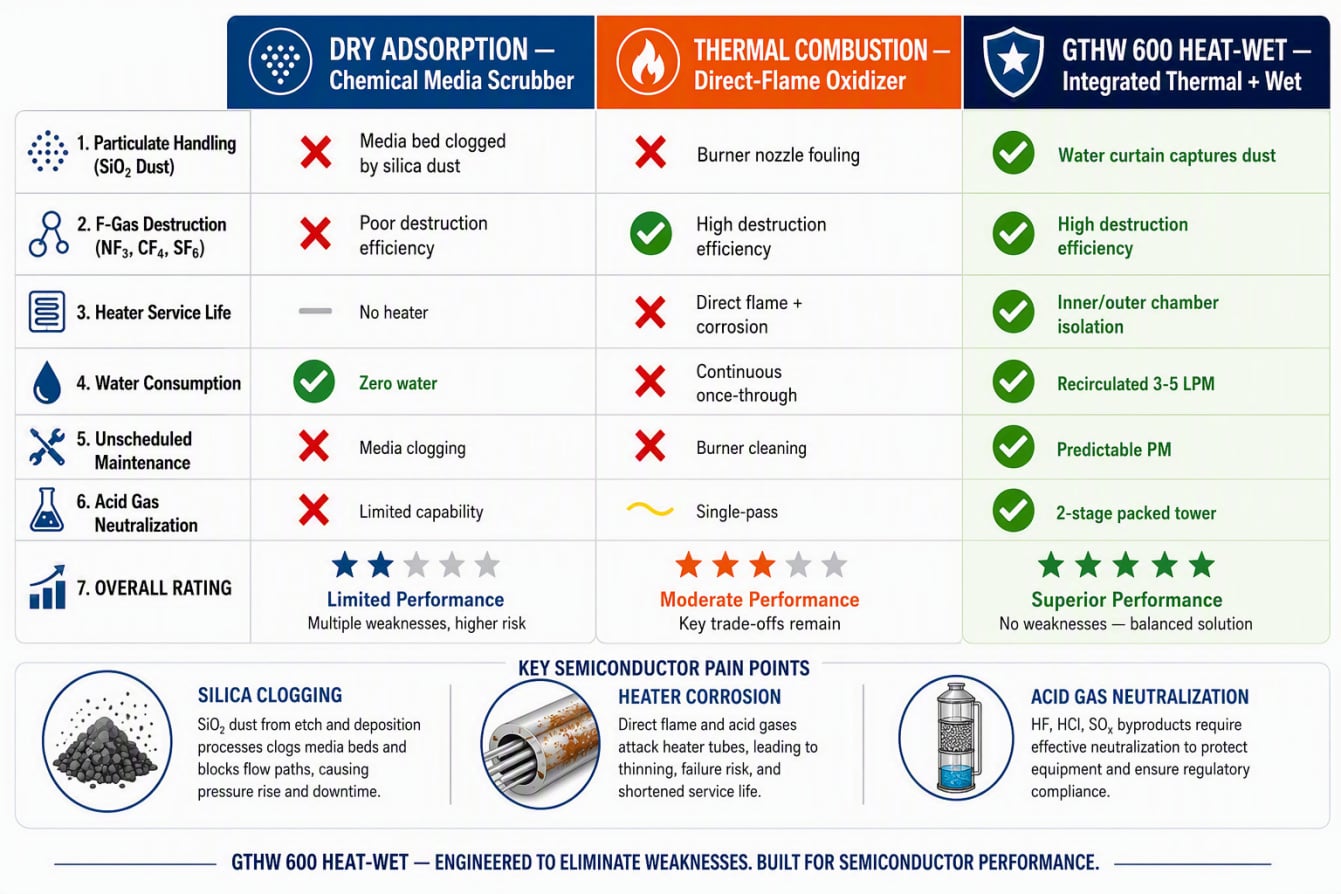
The choice between dry adsorption, combustion, and thermal-wet abatement is not about which technology is "better" — it is about which technology matches the gas stream composition. The GTHW 600's integrated thermal-wet architecture is the preferred choice when the process exhaust simultaneously contains thermally stable compounds (NF3, CF4, SF6) that require high-temperature destruction, acid-forming precursors (DCS, chlorine-based etch chemistries) that require wet scrubbing, and particulate-forming gases (SiH4) that clog dry media.
Three operational metrics where the GTHW 600 differentiates from standalone alternatives:
Heater service life — the dominant maintenance cost in thermal abatement. Direct-contact heater designs in combustion-type scrubbers experience continuous corrosive attack and particulate deposition on the heating element surface. The GTHW 600's inner/outer chamber isolation, combined with Teflon coating on the inner chamber surface, decouples the heater from the process gas environment. This is not an incremental improvement in heater durability — it is a fundamental difference in failure mode. Heaters in isolated-chamber designs fail from normal thermal cycling fatigue; heaters in direct-contact designs fail from chemical attack. The maintenance interval difference between these two failure modes is measured in multiples, not percentages.
Particulate handling — the dominant maintenance cost in dry adsorption. Dry scrubber media beds that process silane-containing exhaust accumulate SiO2 powder that fills the interstitial spaces between adsorbent particles, increasing backpressure and reducing gas contact with active adsorbent surfaces. Media must be replaced not because the chemical adsorption capacity is exhausted, but because the bed is physically clogged. The GTHW 600's water curtain captures particulates in the liquid phase and discharges them through the power drain system — there is no solid media to clog and no unscheduled changeout triggered by particulate loading.
Water consumption and liquid waste — the dominant operating cost concern in wet scrubbing. The GTHW 600 recirculates scrubbing water through the PP tank, with municipal water make-up at only 3-5 LPM. The power drain system discharges wastewater at controlled intervals rather than continuously, reducing total water consumption compared to once-through wet scrubber designs. For fabs in water-constrained regions, this recirculation architecture is a meaningful operational differentiator.
Part 4: SEMI S2 Certification and FMCS Integration
The GTHW 600 carries SEMI S2 certification — the international safety standard for semiconductor manufacturing equipment. For fab procurement teams, this certification eliminates the need for independent safety evaluation, accelerates the vendor qualification process, and satisfies insurance and regulatory documentation requirements. The certification covers electrical safety, fire protection, ergonomics, and hazard warning labeling — the full scope of equipment safety parameters that facility engineers must verify before installation approval.
The standard communication box and 3-color tower light (Run/Standby/Alarm) provide immediate visual status indication on the fab floor and support FMCS integration via Modbus RTU/TCP and other industrial protocols. This transforms the scrubber from a standalone utility device into a monitored, documented node on the facility management network — a requirement for fabs operating under ISO 14001 environmental management or pursuing SEMI S23 energy conservation standards.
Conclusion The GTHW 600's integrated thermal-wet architecture is not a compromise between thermal oxidation and wet scrubbing — it is a deliberate design choice for the gas streams that demand both. For semiconductor fabs processing CVD silane chemistry, etch fluorinated gases, and hydrogen-bearing exhaust through a single abatement system, the question is not whether to choose thermal or wet treatment. The question is whether the system integrates both — with the material engineering to survive the corrosive byproducts of doing so, and the isolation design to keep maintenance intervals aligned with planned fab shutdowns rather than unscheduled tool downtime.
Media Contact & Company Profile
Shenzhen Wofly Technology Co., Ltd. is a 15-year ISO-certified manufacturer specializing in industrial gas system components and engineered abatement solutions. The WOFLY product portfolio includes the GTHW 600 Heat-Wet Scrubber, D-200S Dry Scrubber, gas cylinder cabinets, pressure regulators, valves, and high-purity manifold systems, serving semiconductor, PV solar, laboratory, and chemical industries in 30+ countries. For technical consultation, gas-specific evaluation, or system configuration proposals, contact the WOFLY Engineering Team at www.szwofly.com.