 EN
EN
 AR
AR
 HR
HR
 CS
CS
 NL
NL
 FR
FR
 DE
DE
 IT
IT
 JA
JA
 KO
KO
 NO
NO
 PL
PL
 PT
PT
 RO
RO
 RU
RU
 ES
ES
 SV
SV
 TL
TL
 ID
ID
 VI
VI
 MT
MT
 TH
TH
 TR
TR
 AF
AF
 MS
MS
 AZ
AZ

Helium Recovery 101 — Why Every Industrial Helium User Needs to Understand Recovery Technology Now
Summary Helium is the second most abundant element in the universe, yet it is irreplaceable and increasingly scarce on Earth. Unlike natural gas or nitrogen, helium cannot be manufactured — it is produced exclusively as a trace byproduct of natural gas extraction, and once released into the atmosphere, it escapes into space forever. For industries that depend on helium for leak testing, cryogenic cooling, welding shielding, gas chromatography and semiconductor manufacturing, the question is no longer whether helium prices will rise, but how to use less of it per unit of output. Helium recovery technology — the process of capturing, purifying and reusing helium that would otherwise be vented — has emerged as the only economically viable long-term answer. This article explains how helium recovery works, what makes it technically challenging, and why forward-looking industrial users are building recovery capability before supply disruptions force their hand.
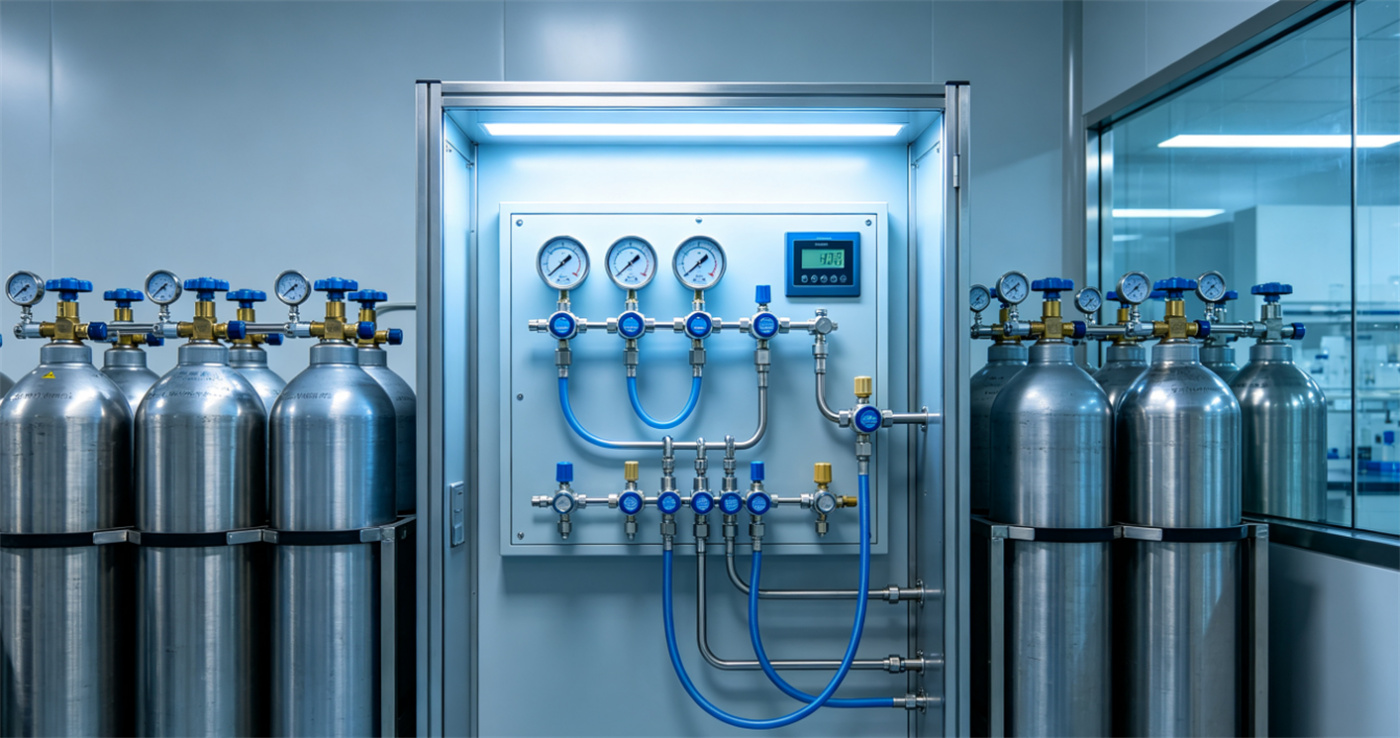
Industrial gas handling infrastructure of the type used in helium recovery systems — gas cabinets, pressure regulation panels, and manifold networks for high-purity gas management
Part 1: Why Helium Cannot Be Replaced — And Why It Cannot Be Manufactured
Helium's unique physical properties make it indispensable across a surprisingly broad range of industries. With a boiling point of -269°C, it is the only substance capable of cooling superconducting magnets in MRI machines and particle accelerators to operational temperatures. As the smallest and lightest inert gas molecule, helium serves as the most sensitive tracer gas for leak detection — essential for verifying the integrity of automotive fuel systems, aerospace components, semiconductor process chambers and medical device packaging. In welding, helium's high thermal conductivity produces deeper penetration and faster travel speeds on aluminum, stainless steel and reactive alloys. In gas chromatography, its inertness makes it the ideal carrier gas for analysis.
What makes helium strategically vulnerable is its supply chain. Helium forms over millions of years through the radioactive decay of uranium and thorium deep within the Earth's crust. It accumulates in the same geological traps as natural gas, from which it is extracted at concentrations typically between 0.1% and 0.5% — meaning that 99.5% to 99.9% of what comes out of a helium-bearing gas well is methane. Only a handful of natural gas processing facilities worldwide are equipped with helium extraction and liquefaction plants. When those facilities experience operational disruptions, political instability or resource depletion, there is no alternative production source to fill the gap.
The US Bureau of Land Management's Cliffside Field in Texas — the historical backbone of global helium supply — has been winding down for years. Qatar's Ras Laffan plant, Russia's Amur complex and a small number of facilities in Algeria and Australia now carry the world's helium supply burden. Each of these sources faces its own geopolitical, logistical and technical constraints. The result is a global helium market where spot prices can swing 200-400% above contract rates, and where force majeure clauses are invoked with increasing frequency.
Part 2: How Helium Recovery Works — The Three-Stage Process
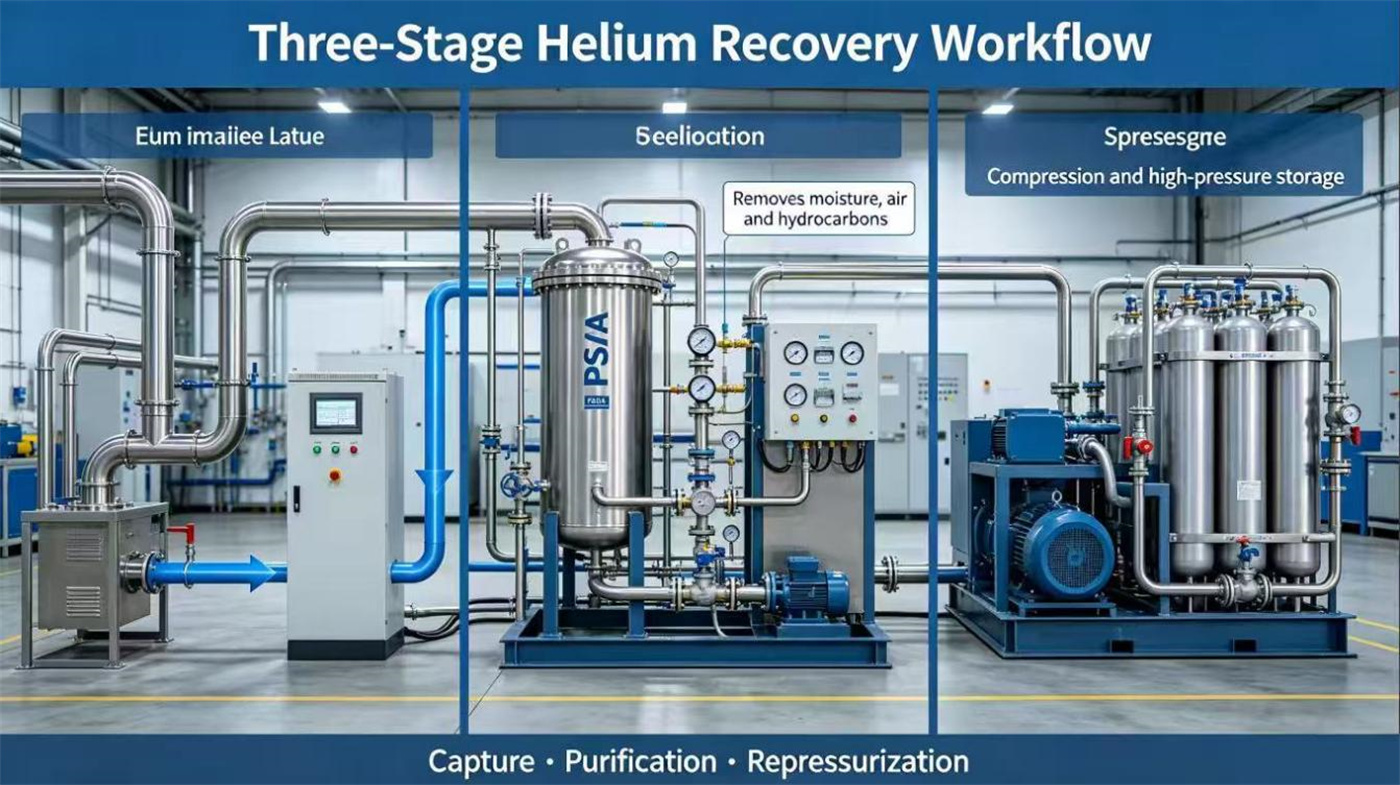
Helium recovery is not a single piece of equipment but an integrated system that performs three sequential functions: capture, purification, and repressurization.
Capture means collecting helium at every point of use before it is vented. In a leak testing station, this means routing the helium-filled test chamber exhaust into a collection manifold instead of releasing it into the room. In a GC-MS laboratory, it means capturing the carrier gas outflow. In a laser welding cell, it means collecting the helium shielding gas that would otherwise dissipate. The engineering challenge at this stage is leak tightness — a recovery system is only as effective as its weakest connection. Every fitting, valve and joint in the collection network must maintain helium-tight integrity at the sub-micron level, because even a 0.1% leak rate across a 24/7 operation can represent thousands of dollars of lost helium annually.
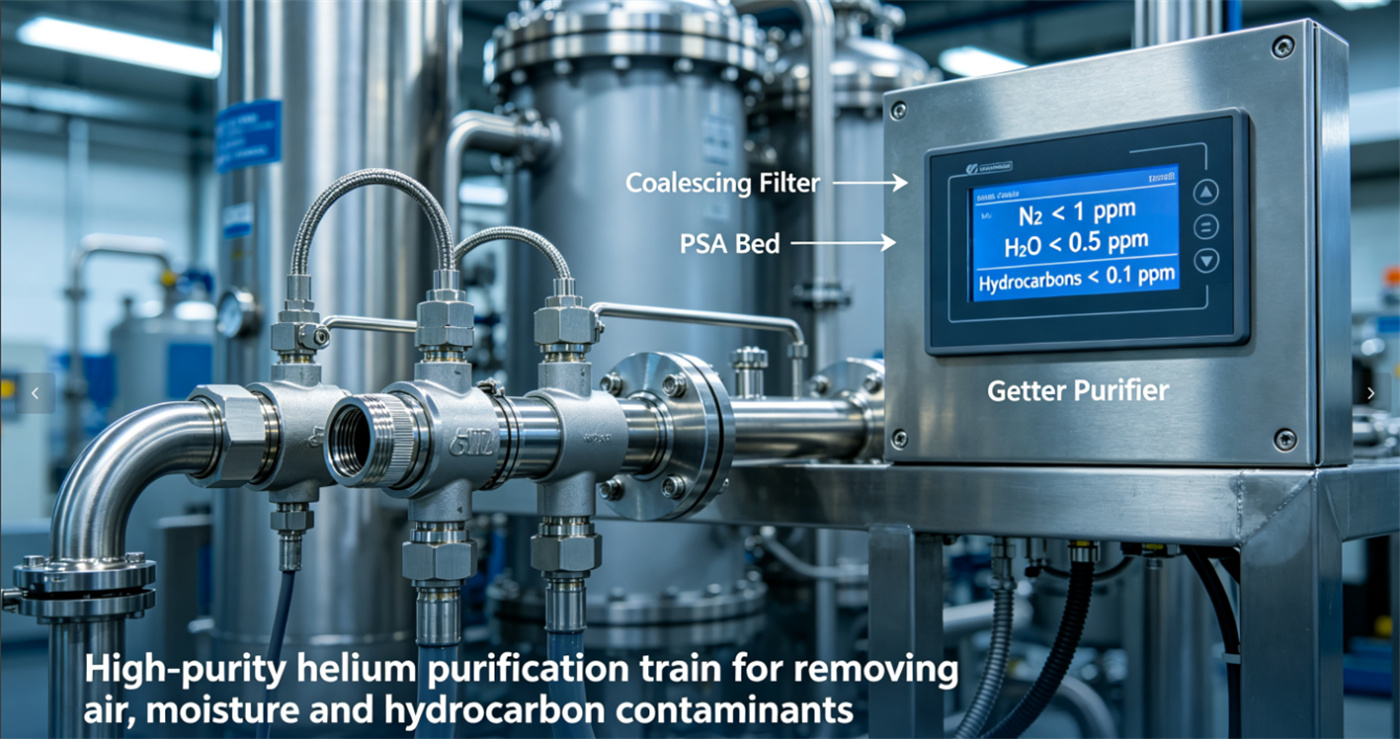
Purification is the most technically demanding stage. Recovered helium is never pure — it carries nitrogen and oxygen from ambient air infiltration, moisture from humidity, oil vapor from compressor lubrication if oil-lubricated compressors are used upstream, and trace hydrocarbons from process contamination. The target purity depends on the application: semiconductor-grade helium requires 99.999% (5N) purity with moisture below 10 parts per billion, while industrial leak testing may accept 99.5%. A typical purification train uses three sequential technologies: coalescing filters to remove aerosols and particulates, pressure swing adsorption (PSA) beds or membrane modules to strip out bulk nitrogen and oxygen, and high-temperature getter purifiers for final trace-level polishing.
Repressurization returns the purified helium to the pressure required by downstream equipment — anywhere from 10 bar for laboratory distribution headers to 200 bar for high-pressure cylinder filling and storage. Oil-free compression is essential at this stage, because any lubricant contamination would undo the purification work and potentially damage downstream analytical instruments or process equipment.
Part 3: The Economics of Recovery — Shorter Payback Than Most Operators Expect
The business case for helium recovery has strengthened dramatically in the past three years. A mid-sized industrial user consuming 1,000 cubic meters of helium annually for leak testing might spend 30,000 to 50,000 per year at current contract prices — and far more if forced to buy on the spot market during allocation cuts. A properly designed recovery system capturing 85-95% of that helium reduces annual purchase requirements to 50-150 cubic meters of make-up gas. At this recovery rate, system payback periods have compressed from the historical 3-5 years to 12-18 months in many regions.
The economics become even more compelling when factoring in supply security. A helium allocation cut — in which a gas supplier reduces delivery volumes by 30%, 50% or more on short notice — can shut down an entire production line. The cost of lost production typically dwarfs the cost of the helium itself. Recovery capability transforms helium from a supply-constrained consumable into a reusable asset, insulating operations from market volatility.
Part 4: Is Your Operation Ready for Helium Recovery?
Not every helium user needs a full recovery system today. The decision depends on three factors: annual helium consumption volume, supply reliability risk in your region, and the purity requirements of your specific applications.
Operations consuming fewer than 200 cubic meters annually with stable contract supply may find that recovery payback periods remain too long to justify the capital investment. Operations consuming 500-2,000+ cubic meters annually, especially those in regions with volatile supply or for whom production downtime carries six- or seven-figure consequences, should begin evaluating recovery options now — before an allocation cut forces a rushed decision.
The recommended starting point is a helium consumption audit: a systematic survey of every helium use point, actual flow rates, consumption patterns across shifts and seasons, and purity requirements by application. This data not only builds the internal business case but also provides the specifications that any recovery system must meet.
For organizations ready to explore helium recovery, partnering with gas system engineering specialists who understand high-purity gas handling — rather than general industrial equipment suppliers — reduces integration risk. The recovery system's capture network, purification train and repressurization stage must all be engineered to the same leak-tightness standards and material compatibility specifications. Companies with demonstrated expertise in semiconductor-grade gas delivery, laboratory gas distribution and industrial gas manifold systems bring the most directly transferable capabilities to helium recovery projects.
As helium transitions from a cheap, abundant industrial gas to a strategic, supply-constrained resource, recovery technology is moving from optional to essential. The organizations that build this capability now will have both a cost advantage and an operational continuity guarantee that their competitors — still waiting for the helium market to "return to normal" — will not.
Media Contact & Company Profile Shenzhen Wofly Technology Co., Ltd. is a 15-year ISO-certified manufacturer of industrial gas system components with deep expertise in high-purity pressure regulation, precision valving, gas cabinet design and manifold system integration. The company's AFKLOK product portfolio includes pressure regulators, valves, compression fittings, gas cabinets and manifold systems serving semiconductor, laboratory, medical and new energy industries in 30+ countries. For helium consumption audits, recovery feasibility assessments or technical consultation, contact the AFKLOK Gas Systems Engineering Team.