 EN
 AR
 HR
 CS
 NL
 FR
 DE
 IT
 JA
 KO
 NO
 PL
 PT
 RO
 RU
 ES
 SV
 TL
 ID
 VI
 MT
 TH
 TR
 AF
 MS
 AZ

Choose a pneumatic fitting by matching four things to the line
Choose a pneumatic fitting by matching four things to the line: connection type (push-to-connect, compression, barb, or threaded), port thread standard, tube outside diameter and material, and body material for the environment. Get the thread standard wrong, and it leaks under vibration, no matter how tight it feels.
Pick the Right Fitting and the Leak Never Starts
Choosing a pneumatic fitting comes down to matching four things to the line: the connection type, the port’s thread standard, the tube’s outside diameter (OD) and material, and the body material for the environment. Think of a push-to-connect fitting as a finger trap for tube: push the tube in, and a ring of steel teeth lets it slide one way but grips the instant it tries to pull back, while an O-ring seals against the tube’s outer skin. That is why a scratched or out-of-round tube leaks even when the fitting is “connected.”
Get the thread standard wrong, and the fitting feels tight after two or three turns, then leaks the moment the line sees vibration or a pressure spike, because NPT and BSP threads are cut at different angles and never seal together. If you pick replacement fittings off the shelf, work through these four choices in order, and you’ll stop the leak before it starts.
The Four Choices That Stop a Leak
1. Connection type: match it to how often the joint moves
Four connection types cover almost every pneumatic line, and each seals differently.
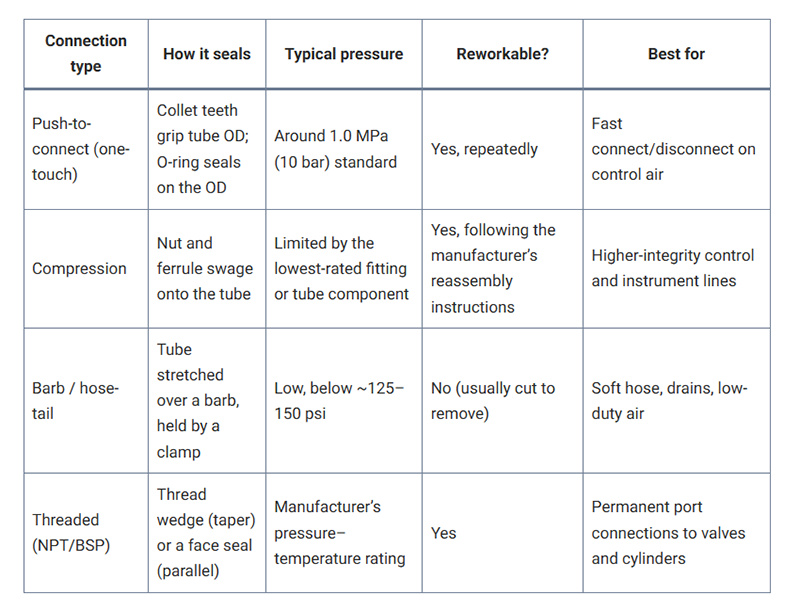
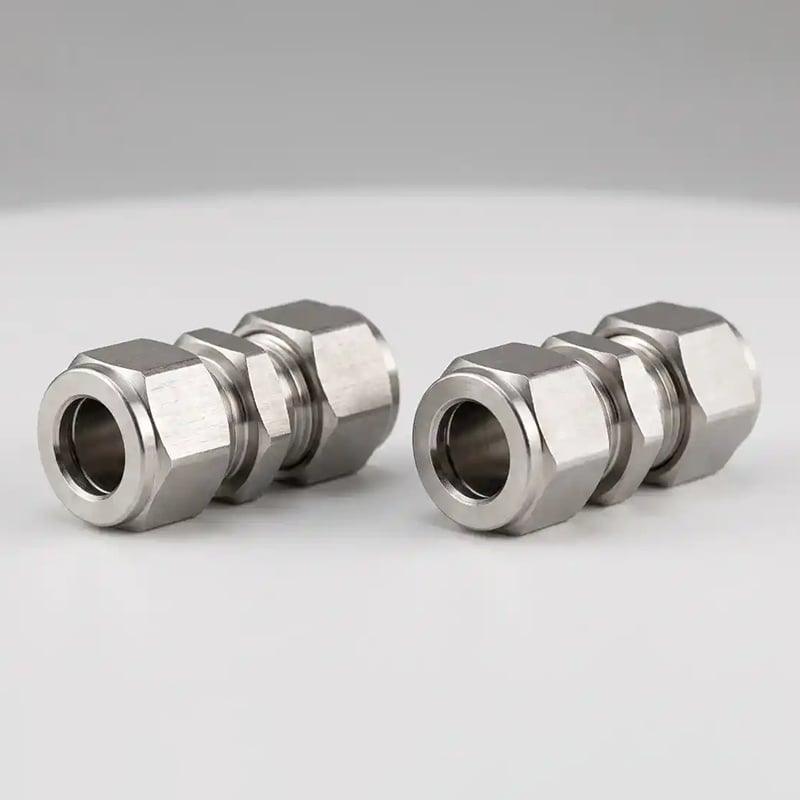
Push-to-connect is the shop default for speed. Choose compression when vibration or line integrity matters; it works on the same grip-and-seal principle as a tube fitting. Barb fittings are cheap but low-pressure. Check the hose and fitting manufacturer’s pressure limits. Threaded connections are the structural backbone, and their whole reliability rides on the next choice.
2. Thread standard: the mismatch that fails under vibration
This causes the most callbacks. NPT (National Pipe Taper) uses a 60° thread angle and is tapered, so it seals metal-to-metal on the threads and requires a thread sealant. BSPT (British Standard Pipe Taper) uses a 55° Whitworth profile, also tapered but at a different angle. BSPP (British Standard Pipe Parallel) and metric parallel threads do not taper at all; the thread only holds the fitting, and the seal is made separately on a face by a bonded washer or O-ring.
Mix a 60° NPT with a 55° BSP, and they bite for a couple of turns, feel tight, and never form a continuous seal. Forcing them can gall or crack the female port. The fix is a purpose-made adapter with the correct standard on each side. Two field rules save the most grief: taper threads (NPT, BSPT) seal on the threads and take sealant; parallel threads (BSPP, metric) seal on a face, so PTFE tape on them does nothing useful and only sheds debris into valves.
The pneumatic port standard makes the incompatibility explicit. ISO 16030:2022, the standard for pneumatic connection ports, states plainly that its parallel-thread ports “are not intended to connect with… threads that conform to ISO 7-1” (the BSP taper standard). The reference standard for NPT itself is ANSI/ASME B1.20.1. When in doubt, gauge or identify the thread before you fit it; do not judge it by feel.
Frequently Asked Questions
Push-to-connect, compression, or threaded: which do I use?
Push-to-connect for occasional disconnection of control air drops; use a suitable quick-disconnect coupling for frequent connection cycles. Compression where vibration or line integrity matters. Threaded for permanent port connections into valves and cylinders. Barb only for low-pressure soft hose, below roughly 125–150 psi.
How do I tell an NPT thread from a BSP thread?
They are cut to different angles: NPT at 60° and BSP at 55°, so a thread gauge is the reliable check. If two tapered threads bind unexpectedly, stop and verify their standard, size and condition before fitting an adapter or replacement.
Brass or stainless for a humid Malaysian plant?
Brass for dry interior compressed air. Move to 316 stainless for washdown areas, coastal or marine air, and corrosive atmospheres, where brass can dezincify and plated fittings eventually corrode through.
Why does my push-to-connect fitting keep leaking?
Usually the tube isn’t pushed fully home, is cut at an angle, is scratched, or has the wrong OD. The fitting seals on the tube’s outside diameter, so a clean square cut and a full push are part of the seal.